Interest Growth Strategy: Invest $100 Today for 2026 Gains
Have you ever considered how a small amount of money, like $100, could potentially grow into something much larger?
The concept of financial growth often feels out of reach for many, but the truth is, you can invest $100 today and harness the incredible power of compounding interest, setting yourself up for a more robust financial future by 2026 and beyond.
This isn’t about getting rich overnight; it’s about understanding a fundamental principle of wealth accumulation that is accessible to everyone.
Understanding the Magic of Compounding Interest
Compounding interest is often referred to as the “eighth wonder of the world” because of its extraordinary ability to turn small amounts of money into substantial wealth over time.
Unlike simple interest — which is calculated only on your original investment — compounding interest allows both your principal and your earned interest to generate additional interest.
In simple terms, your money begins working for you — and then your interest starts working for you too.
That’s where the magic happens.
How Compounding Interest Really Works
Let’s break it down clearly.
If you invest $100 and earn a 7% annual return:
Year 1:
You earn $7 in interest.
Your total becomes $107.
Year 2:
You now earn 7% on $107 — not just the original $100.
That means $7.49 in interest.
Your total becomes $114.49.
Year 3:
You earn interest on $114.49.
Growth continues to accelerate.
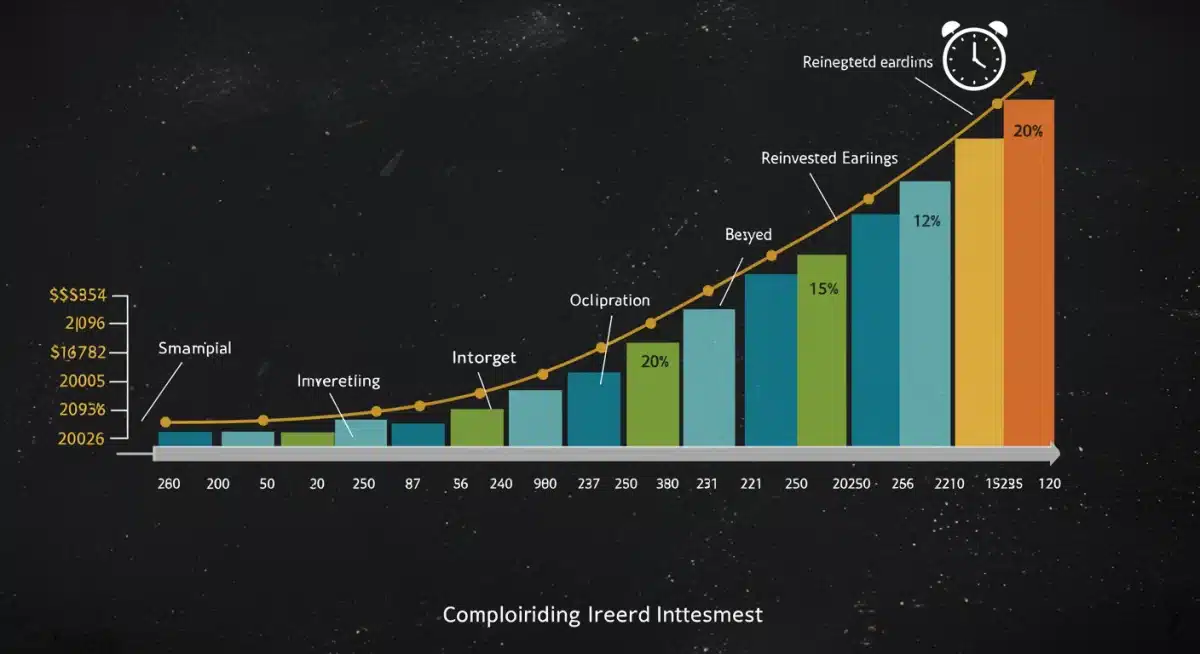
Each year, the base amount increases. And because interest is calculated on a growing balance, the gains become progressively larger.
This is why compounding creates exponential growth, not linear growth.
The Snowball Effect of Interest
Think of compounding interest like a snowball rolling downhill.
At first, the snowball is small. The growth seems slow. But as it rolls:
It gathers more snow.
Its surface area increases.
It grows faster with each rotation.
Similarly, compounding interest accelerates as your balance grows.
Early on, growth may look modest. But over longer periods — 10, 20, or 30 years — the difference becomes dramatic.
Time is the true accelerator of compounding interest.
Why Time Matters More Than Amount
Many new investors believe they need large capital to benefit from compounding interest. In reality, time is more important than the starting amount.
Starting with $100:
Makes investing feel accessible
Reduces fear of risk
Allows you to observe compounding in action
Builds financial confidence
A small investment started early often outperforms a large investment started late — simply because it had more time to compound.
The Psychological Power of Starting Small
Beginning with $100 removes intimidation from investing. It transforms compounding interest from a theoretical concept into a tangible experience.
You begin to see:
How returns fluctuate
How reinvested interest boosts growth
How patience rewards discipline
Once you understand how interest compounds, investing shifts from uncertainty to strategy.
Exponential Growth Over Decades
The most powerful feature of compounding interest appears in later years.
For example:
In the early years, growth feels steady.
In the middle years, interest earned becomes noticeable.
In the later years, annual interest can exceed your original investment.
At that stage, compounding does more work than your contributions.
This is why investors who remain patient and consistent often see dramatic wealth accumulation over time.
Compounding interest is not about quick wins. It’s about long-term momentum.
Your initial $100 may seem small today. But when combined with:
Reinvested interest
Consistent contributions
Time in the market
Emotional discipline
It becomes the foundation of exponential growth.
The magic of compounding interest lies not in complexity — but in consistency and patience.
The snowball effect in action
The earlier you start, the more time your money has to compound. Even a modest return can lead to significant gains when given enough time. This is why financial experts consistently advocate for early and consistent investing, regardless of the initial sum.
Time is your greatest ally: The longer your money is invested, the more pronounced the compounding effect.
Reinvesting dividends: If your investment pays dividends, reinvesting them further fuels the compounding process.
Consistency matters: Regular contributions, even small ones, significantly boost long-term returns.
Understanding compounding interest isn’t just about theoretical knowledge; it’s about recognizing a practical tool that can transform your financial trajectory.
By grasping how this mechanism works, you can make informed decisions even with a modest initial investment like $100, setting a strong foundation for future financial success.
Why Start with Just $100? Breaking Down Barriers
Many people believe that investing requires large sums of money, often thousands of dollars. This misconception can be a significant barrier to entry for aspiring investors. However, starting with a modest amount like $100 is not only possible but also highly beneficial, serving as an excellent entry point into the world of investing.
The primary reason to begin with $100 is to overcome the psychological barrier tied to interest and investing. Many people delay building wealth because they believe earning meaningful interest requires a large amount of capital. Starting with $100 proves that generating interest is accessible and that you don’t need immense funds to begin benefiting from compounding.
Accessible entry to investment platforms
Today, numerous investment platforms cater to small investors, offering low minimum deposits and fractional share investing. This innovation has democratized access to markets, making it easier than ever to invest $100 today.
Robo-advisors: Platforms like Betterment and Wealthfront allow you to start with small amounts and offer automated portfolio management.
Brokerage apps: Apps such as Robinhood, Fidelity Go, and Charles Schwab offer commission-free trading and often allow fractional share purchases.
ETFs and index funds: These investment vehicles provide diversification even with a small capital, as they represent a basket of stocks or bonds.
Starting small means you can experiment, make mistakes, and learn valuable lessons without catastrophic financial consequences.
It’s an educational journey where every dollar invested contributes to both your financial growth and your investment literacy. The goal isn’t just to make money, but to understand how money grows and how market dynamics work.
Choosing the Right Investment Vehicle for Your $100
Once you’ve decided to invest $100 today, the next crucial step is to select the appropriate investment vehicle. With such a modest sum, your options might seem limited, but modern financial markets offer several viable pathways designed for small-scale investments.
The key is to choose an option that aligns with your risk tolerance and financial goals, even if those goals are just to learn and grow.
For $100, focusing on low-cost, diversified options is generally the wisest approach. Individual stocks can be risky with such a small amount, as a single company’s performance can heavily impact your portfolio.
Instead, consider options that spread your investment across multiple assets, reducing specific company risk.
Diversified low-cost options
Exchange-Traded Funds (ETFs) and mutual funds, particularly index funds, are excellent choices for beginners. They offer immediate diversification and are managed by professionals, making them relatively hands-off investments.
ETFs: These are funds that hold a collection of stocks, bonds, or other assets. They trade like stocks on exchanges and often have very low expense ratios. You can buy fractional shares of many popular ETFs with $100.
Index Funds: A type of mutual fund or ETF that aims to replicate the performance of a specific market index, such as the S&P 500. They offer broad market exposure and typically have lower fees than actively managed funds.
Robo-Advisor Portfolios: These automated investment services build and manage diversified portfolios based on your risk profile. They often have low minimums and can auto-invest your $100 into a mix of ETFs.
Another emerging option is fractional shares, which allow you to buy a portion of a high-priced stock like Amazon or Google with your $100.
While this offers exposure to specific companies, remember that diversification through ETFs or index funds generally provides a more stable growth path for small sums. Each option presents unique benefits, but diversification and low fees should be prioritized when you invest $100 today.
Setting Realistic Expectations: Growth by 2026
When you invest $100 today with the expectation of seeing growth by 2026, it’s crucial to set realistic expectations. While compounding interest is powerful, the timeframe of a few years means that a $100 initial investment will likely not transform into a life-changing sum.
However, it will demonstrate the principles of growth and provide valuable experience.
The primary goal for this short-to-medium term investment is not massive wealth accumulation, but rather financial education and the tangible experience of seeing your money work for you.
By 2026, you will have a clearer understanding of market fluctuations, the impact of interest rates, and the importance of consistent investing.
Factors influencing your $100 investment growth
Several variables will affect how much your $100 grows by 2026. Understanding these factors helps manage expectations and strategize for future investments.
Rate of Return: The annual percentage gain on your investment. Higher returns mean faster growth, but often come with higher risk.
Time Horizon: Although 2026 is a relatively short period, it’s enough time to observe initial compounding effects. Longer horizons yield significantly greater results.
Additional Contributions: While the focus is on the initial $100, adding even small amounts regularly will dramatically boost your 2026 balance.
Fees and Taxes: Investment fees and capital gains taxes can eat into your returns. Opt for low-fee options and understand tax implications.
For example, if your $100 earns an average annual return of 7%, by 2026 (assuming you invest at the beginning of 2024), your investment would grow to approximately $114.49.
This might not seem like much, but it represents a 14.49% return solely from the power of compounding on a small initial sum, laying the groundwork for more substantial future investments.

Building a Habit of Regular Investing to Maximize Interest
The most powerful way to unlock the full potential of interest is not through one large investment — it’s through consistency. Building a habit of regular investing allows interest to compound steadily, turning small, manageable contributions into meaningful long-term wealth.
Interest rewards discipline more than intensity.
When you invest consistently, you create a rhythm that strengthens both your financial growth and your mindset. Instead of wondering when to invest or how much to contribute, the process becomes automatic and predictable.
Why Regular Contributions Amplify Interest
Compounding interest works best when:
Contributions are frequent
Earnings are reinvested
Withdrawals are minimized
Time horizon is long
Every new contribution increases the base amount that earns interest. Over time, your accumulated interest begins generating additional interest, accelerating growth in ways that may seem small initially but become significant over the years.
Set up automatic transfers: Schedule a small amount, perhaps $25 or $50, to be transferred from your checking account to your investment account each month.
Increase contributions gradually: As your income grows or expenses decrease, consider incrementally increasing your monthly investment amount.
Avoid market timing: Focus on consistent investing over trying to predict market movements. Time in the market generally beats timing the market.
The discipline you build by consistently investing, even small amounts, will far outweigh the initial sum you put in.
By 2026, your $100 might have grown modestly, but the habit of investing it instilled will be far more valuable, preparing you for bigger financial moves and ensuring your money continues to compound effectively for years to come.
Mitigating Risks and Learning as You Go
Investing, regardless of the amount, always involves some level of risk. However, with a small sum like $100, the financial risk is minimal, making it an ideal opportunity to learn about market volatility and risk management without significant exposure.
Understanding and mitigating these risks is a crucial part of any investment journey, especially when you are just starting.
The goal is not to eliminate risk entirely, which is impossible, but to manage it intelligently. For a $100 investment, this primarily involves choosing diversified, low-cost options and focusing on long-term growth rather than short-term gains.
This approach allows you to experience market ups and downs firsthand, building resilience and knowledge.
Practical risk management for small investments
Even with $100, you can practice sound risk management principles that will serve you well as your investment portfolio grows.
Diversify your $100: As mentioned, use ETFs or index funds to spread your investment across many companies, rather than putting all $100 into one stock.
Educate yourself: Continuously learn about market trends, economic indicators, and different investment strategies. Knowledge is your best defense against bad decisions.
Don’t panic sell: Market downturns are a normal part of investing. Avoid making emotional decisions to sell your investments during these periods.
Review and adjust: Periodically check your investment’s performance and ensure it still aligns with your goals, but resist the urge to constantly tinker with it.
Learning through experience is invaluable. By investing $100 today and observing its performance by 2026, you’ll gain practical insights into how markets operate, how your chosen investment vehicle behaves, and how your own emotions can influence your financial decisions.
This hands-on learning is an investment in your financial literacy that will pay dividends far beyond the monetary returns on your initial $100.
| Key Point | Brief Description |
|---|---|
| Compounding Power | Interest earns interest, leading to exponential growth over time. |
| Starting Small | $100 is an accessible entry point to investing, building confidence and knowledge. |
| Investment Vehicles | Low-cost ETFs, index funds, and robo-advisors are ideal for small sums. |
| Long-Term View | Consistency and patience are crucial for maximizing compounding over decades. |
Frequently Asked Questions About Investing $100
While $100 won’t make you rich by 2026, it will demonstrate the power of compounding. With a typical annual return of 7%, your $100 could grow to approximately $114.49 in two years. The real value lies in the experience gained and the foundation laid for future, larger investments.
Robo-advisors like Betterment and Wealthfront, and brokerage apps such as Robinhood, Fidelity Go, and Charles Schwab are excellent choices. Many offer fractional share investing and low minimum deposits, making them accessible for a $100 initial investment.
For $100, diversified, low-cost options are recommended. Exchange-Traded Funds (ETFs) or index funds are ideal as they spread your investment across many assets, reducing risk. Some platforms also allow you to buy fractional shares of popular stocks or ETFs.
All investing has risk, but $100 is a low-risk entry point. Mitigate risk by choosing diversified investments like ETFs. Educate yourself, avoid emotional selling during market downturns, and focus on long-term growth. The primary risk with $100 is not financial loss, but failing to learn.
Consistency is paramount. While $100 provides a starting point, regularly adding even small amounts over time significantly amplifies the compounding effect. Automating contributions, even $25 a month, builds a powerful habit that will lead to far greater wealth accumulation than a one-time $100 investment alone.
Conclusion
The journey of financial growth, much like any significant endeavor, often begins with a single, deliberate step. When you choose to invest $100 today, you’re not just putting money into the market; you’re initiating a powerful lesson in financial literacy and activating the remarkable force of compounding interest.
By 2026, while your initial $100 might not have transformed into a fortune, it will undoubtedly have grown, providing tangible proof of how money can work for you.
More importantly, this small act of investment cultivates the essential habits of patience, consistency, and informed decision-making, which are the true cornerstones of enduring wealth. Embrace the opportunity to start small; the knowledge and experience gained will be invaluable assets for your financial future.