Social Media’s Impact on 2026 US Political Landscape
As we edge closer to 2026, the question of how the 2026 political landscape is being shaped by social media discourse becomes increasingly urgent and complex. Social media platforms are no longer just tools for personal connection;
they are potent arenas where political narratives are forged, public sentiment is swayed, and electoral outcomes are profoundly influenced. Understanding this evolving dynamic is crucial for anyone seeking to comprehend the future of American politics.
The Algorithmic Architects of Public Opinion
The algorithms governing social media platforms are highly sophisticated, constantly learning and adapting to user behavior.
These algorithms play a pivotal role in shaping what political content individuals encounter, often creating echo chambers and reinforcing existing biases. This selective exposure can significantly impact how voters perceive candidates and issues leading up to 2026.
Platforms like X (formerly Twitter), Facebook, and TikTok employ complex systems that prioritize engagement, which often means amplifying emotionally charged or polarizing content. This can lead to a fragmented public discourse, where consensus becomes harder to achieve, and political divides deepen.
Echo Chambers and Filter Bubbles
The concept of echo chambers is not new, but social media has amplified their effect. Users are often exposed primarily to information that confirms their existing beliefs, leading to a distorted view of broader public sentiment. This makes it challenging for nuanced political discussions to thrive.
Reinforcement of existing beliefs: Algorithms prioritize content aligning with past interactions.
Reduced exposure to diverse viewpoints: Users rarely encounter opposing perspectives.
Increased polarization: Homogeneous information environments can harden political stances.
Difficulty in finding common ground: Shared understanding diminishes as viewpoints diverge.
The impact of these algorithmic architects extends beyond individual perception, influencing everything from policy debates to election strategies. Political campaigns must now contend with not just delivering their message, but ensuring it penetrates these digital barriers.
In conclusion, the invisible hand of social media algorithms is a primary force sculpting the 2026 political landscape. Their design dictates the flow of information, inadvertently contributing to a more polarized and less informed electorate, a challenge that requires significant attention from both policymakers and the public.
Campaign Strategies in the Digital Age
Political campaigns for 2026 are increasingly recognizing social media as their primary battleground for hearts and minds.
The traditional methods of campaigning, while still relevant, are now often overshadowed by the immediate, pervasive, and highly targeted nature of digital outreach.
This shift demands new skills, new budgets, and a constant adaptation to rapidly changing platform dynamics.
From micro-targeting specific demographics with tailored messages to leveraging influencers for broader reach, campaigns are employing sophisticated digital strategies.
The ability to react in real-time to events and opponent statements has become a critical advantage, making social media an indispensable tool for electoral success.
Micro-targeting and Personalized Messaging
Social media allows campaigns to gather vast amounts of data on potential voters, enabling them to craft highly personalized messages. This precision can be incredibly effective but also raises concerns about privacy and the potential for manipulative tactics.
Demographic precision: Messages tailored to age, location, and interests.
Behavioral insights: Content aligned with past online activity and preferences.
Increased engagement: Personalized content often resonates more deeply with recipients.
Ethical considerations: Debates surrounding data privacy and targeted persuasion.
The rapid evolution of social media platforms means that campaign teams must be agile and innovative. What works today might be obsolete tomorrow, pushing strategists to continuously experiment with new formats, content types, and engagement models to capture voter attention.
Ultimately, the effectiveness of 2026 political campaigns will largely hinge on their ability to master the intricacies of social media. Campaigns that fail to adapt to these digital realities risk being left behind in the race for political influence and voter support.
The Rise of Citizen Journalism and Misinformation
Social media has democratized information dissemination, allowing anyone with a smartphone to become a reporter.
This rise of citizen journalism offers immediate, unfiltered perspectives on events, but it also creates fertile ground for the rapid spread of misinformation and disinformation, a significant challenge for the 2026 political landscape.
The speed at which false narratives can go viral poses a serious threat to electoral integrity and public trust. Distinguishing between credible news and fabricated content becomes increasingly difficult for the average user, impacting their ability to make informed political decisions.

Fact-Checking Challenges and Verification
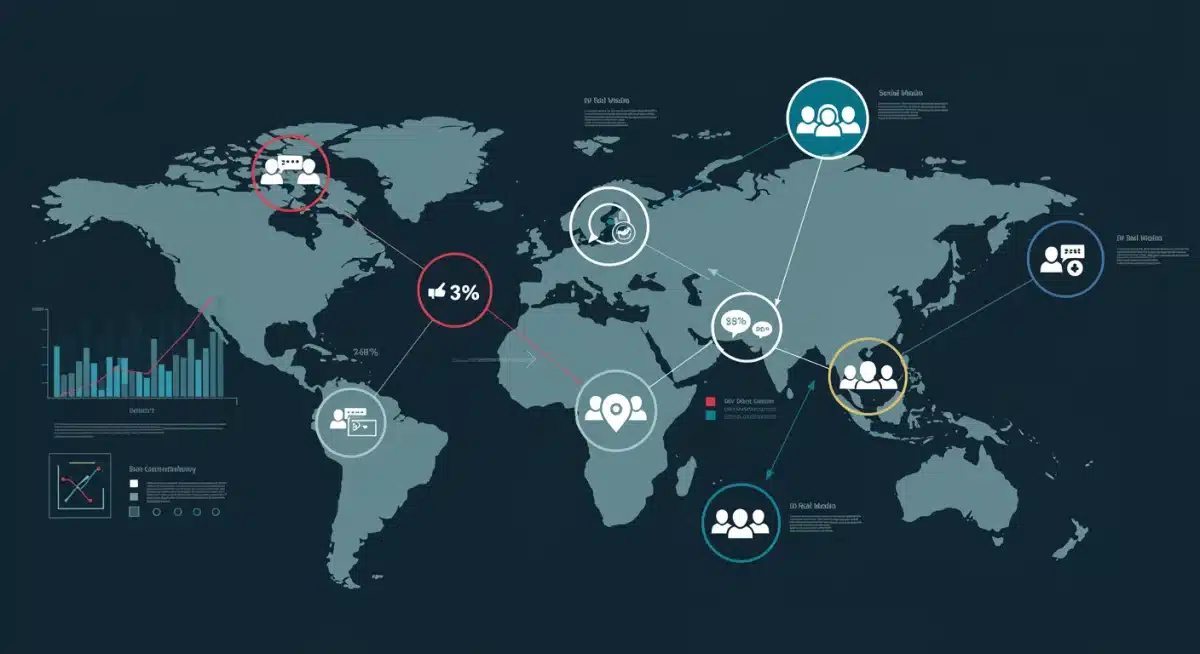
The sheer volume of content generated daily on social media overwhelms traditional fact-checking mechanisms. Verifying the authenticity of images, videos, and claims in real-time is a monumental task, often lagging behind the viral spread of false information.
Organizations dedicated to fighting misinformation are constantly playing catch-up, and their efforts, while crucial, often struggle to counteract the initial impact of misleading content. This dynamic has profound implications for how political narratives are perceived and trusted.
Volume of content: Overwhelming amount of daily posts and shares.
Speed of spread: Misinformation often goes viral before verification.
Deepfakes and AI-generated content: Increasing sophistication of fabricated media.
Erosion of trust: Public skepticism towards all news sources due to pervasive falsehoods.
The battle against misinformation is not just a technological one; it’s a societal challenge that requires media literacy, critical thinking, and a commitment from platforms to implement more effective safeguards. The integrity of the 2026 elections could heavily depend on mitigating this issue.
In essence, while citizen journalism empowers individuals, it simultaneously exacerbates the problem of misinformation. This duality presents a complex hurdle for maintaining an informed electorate and a healthy democratic process in the lead-up to 2026.
Mobilization and Activism in the Digital Sphere
Social media platforms have revolutionized political mobilization and activism, enabling movements to form, grow, and exert influence at unprecedented speeds.
For the 2026 political landscape, this means that grassroots efforts can quickly gain traction, challenging established political structures and bringing new issues to the forefront.
From organizing protests to raising awareness for specific causes, digital tools provide a powerful avenue for collective action. This accessibility can empower marginalized communities and amplify voices that might otherwise be unheard in traditional media landscapes.
However, the ephemeral nature of online activism also presents challenges. While it’s easy to sign a petition or share a post, translating online engagement into sustained, real-world political action remains a significant hurdle for many movements.
Digital Organizing and Grassroots Power
The ability to connect with like-minded individuals across geographical boundaries has transformed grassroots organizing.
Activists can quickly disseminate information, coordinate events, and build solidarity, creating pressure points for politicians and policymakers.
Rapid information sharing: Instant communication about causes and events.
Community building: Connecting individuals with shared political interests.
Event coordination: Organizing protests, rallies, and digital campaigns efficiently.
Amplification of marginalized voices: Providing platforms for underrepresented groups.
The success of future political movements in 2026 will likely depend on their ability to effectively bridge the gap between online enthusiasm and offline action. This involves not just digital savvy, but also strong leadership and a clear strategic vision.
Ultimately, social media serves as a double-edged sword for mobilization: a powerful catalyst for change, yet one that requires careful navigation to ensure lasting impact beyond fleeting online trends.
Regulatory Challenges and Platform Accountability
As social media’s influence on the 2026 political landscape grows, so too does the scrutiny from governments and the public regarding platform accountability.
The lack of robust regulation has allowed issues such as content moderation failures, data privacy breaches, and the spread of harmful content to proliferate, prompting calls for legislative action.
Policymakers face the daunting task of developing regulations that protect free speech while simultaneously combating abuse and ensuring platform responsibility. The global nature of these companies adds another layer of complexity, as national laws struggle to keep pace with digital innovation.
Content Moderation and Free Speech Debates
The debate over content moderation is at the heart of regulatory discussions. Platforms are pressured to remove hate speech and misinformation, but this often clashes with principles of free speech, leading to difficult decisions and accusations of bias.
Defining what constitutes harmful content without stifling legitimate political discourse is a delicate balance. The sheer scale of user-generated content makes consistent and fair moderation an almost impossible task, leading to inconsistencies and ongoing controversy.
Balancing free speech and safety: The constant tension between protecting expression and preventing harm.
Defining harmful content: Subjectivity in what constitutes hate speech or misinformation.
Algorithmic bias: Concerns that moderation tools may unfairly target certain viewpoints.
Transparency in moderation: Calls for clearer rules and processes from platforms.
The outcome of these regulatory challenges will significantly shape the environment in which the 2026 political discourse unfolds. Governments and tech companies must collaborate to create frameworks that foster a healthier, more responsible digital public square.
In conclusion, the intersection of political influence and social media platforms necessitates urgent regulatory intervention.
Striking the right balance between innovation, free expression, and public safety will be key to safeguarding democratic processes in the digital age.
The Evolving Role of Traditional Media and Social Media Integration
The traditional media landscape, once the primary gatekeeper of political information, has been irrevocably altered by the omnipresence of social media.
For the 2026 political landscape, this means that newspapers, television, and radio must adapt their strategies, often integrating social media into their reporting and distribution models to remain relevant and competitive.
Journalists now routinely break news on platforms like X, engage directly with audiences, and source stories from viral content.
This integration blurs the lines between traditional and new media, creating a hybrid ecosystem where information flows through multiple channels simultaneously.

However, this integration also presents challenges, such as maintaining journalistic integrity amidst the pressure for speed and virality, and combating the spread of misinformation that often originates on social platforms.
Synergy and Competition in News Dissemination
Traditional media outlets are increasingly using social media not just to share their content, but also as a source of breaking news and public sentiment. This synergy can enhance reporting, but it also means competing with individual users and alternative news sources for attention.
The need for speed in the digital age can sometimes compromise the rigorous fact-checking and editorial oversight that characterize traditional journalism. Finding a balance between rapid dissemination and accuracy is an ongoing struggle.
Content amplification: Using social media to extend reach of news stories.
Audience engagement: Direct interaction with readers and viewers.
News sourcing: Monitoring social trends and breaking stories.
Maintaining credibility: Upholding journalistic standards in a fast-paced environment.
The future success of traditional media in influencing the 2026 political landscape will depend on its ability to leverage social media’s strengths while mitigating its weaknesses. Adapting to this new reality is not just about survival, but about redefining their essential role in a digital democracy.
In summary, the relationship between traditional media and social media is one of complex interdependence. Their evolving integration will continue to shape how political news is consumed, understood, and debated throughout the 2026 election cycle and beyond.
The Future of Political Discourse: Trends and Predictions for 2026
Looking ahead to 2026, several trends suggest that social media’s role in shaping the political landscape will only intensify. The continuous innovation in platform features, coupled with evolving user behaviors, guarantees a dynamic and often unpredictable environment for political discourse.
We can anticipate a greater sophistication in AI-driven content generation, hyper-personalized political advertising, and an even more blurred line between entertainment and political messaging. These developments will present both opportunities and profound challenges for democratic processes.
The increasing prevalence of augmented reality (AR) and virtual reality (VR) in social interactions could also introduce new dimensions to political campaigning, offering immersive experiences that could either deepen engagement or further manipulate perceptions.
Emerging Technologies and Their Political Implications
The rapid advancement of technologies like generative AI and deepfake capabilities poses significant questions for the integrity of political discourse. The ability to create highly realistic but entirely fabricated content could make it even harder for citizens to discern truth from fiction.
Platforms will be under immense pressure to develop advanced detection and labeling tools, but the arms race between content creators and content moderators is likely to continue, making vigilance and media literacy more crucial than ever.
AI-generated narratives: Creation of persuasive, targeted political content.
Deepfake campaigns: Use of fabricated audio and video to discredit opponents.
Immersive campaigning: AR/VR for interactive political experiences.
Enhanced data analytics: More precise voter profiling and prediction.
The 2026 political landscape will undoubtedly be a testing ground for how societies adapt to these technological shifts. The ability of institutions, media, and individuals to navigate this increasingly complex digital terrain will be paramount.
In conclusion, the future of political discourse on social media points towards a landscape of heightened technological sophistication and increased complexity. Preparing for these trends will be essential for safeguarding democratic principles and fostering an informed citizenry.
| Key Aspect | Impact on 2026 Politics |
|---|---|
| Algorithmic Influence | Shapes information exposure, reinforcing biases and fragmenting public discourse. |
| Campaign Strategies | Enables micro-targeting, real-time response, and influencer marketing for electoral success. |
| Misinformation Spread | Challenges fact-checking, erodes trust, and impacts informed voter decision-making. |
| Mobilization Power | Facilitates rapid grassroots organizing and activism, amplifying diverse voices. |
Frequently Asked Questions About Social Media and 2026 Politics
Algorithms prioritize content users are likely to engage with, often reinforcing existing beliefs and creating echo chambers. This limits exposure to diverse viewpoints, which can lead to increased political polarization as individuals receive a skewed perception of public opinion.
AI is expected to enhance micro-targeting for political advertising, predict voter behavior more accurately, and potentially generate highly personalized campaign messages. It also poses risks with deepfake technology and automated disinformation campaigns, raising ethical concerns.
Social media has the potential to boost voter turnout by making political information more accessible and facilitating voter registration drives. Its ability to mobilize grassroots efforts and spread awareness on key issues can encourage greater participation, especially among younger demographics.
Key challenges include balancing free speech with content moderation to combat hate speech and misinformation. Regulators also grapple with data privacy, platform transparency, and ensuring fair electoral competition without stifling innovation or legitimate political discourse.
Individuals can combat misinformation by critically evaluating sources, cross-referencing information with reputable news outlets, and being wary of sensational headlines. Developing strong media literacy skills and reporting suspicious content to platforms are crucial steps in fostering a healthier online environment.
Conclusion
The intricate dance between social media and politics is undeniably shaping the 2026 political landscape in profound and multifaceted ways. From the subtle nudges of algorithmic curation to the overt power of digital mobilization, these platforms are redefining how political narratives are constructed, consumed, and contested.
The challenges of misinformation, polarization, and regulatory oversight are significant, demanding continuous adaptation from political actors, media organizations, and citizens alike.
As we move closer to 2026, understanding these dynamics will not merely be an academic exercise but a critical necessity for navigating the complexities of modern democracy and fostering a more informed and engaged citizenry.
The future of political discourse is undeniably digital, requiring vigilance, critical thinking, and a proactive approach to harness its potential while mitigating its inherent risks.