Shorter Attention Spans: Is 6-Second Content the Future?

The pervasive influence of digital media has undeniably led to widespread shorter attention spans, prompting a critical examination of whether ultra-short, 6-second content is the future for effective audience engagement.
In our increasingly digital world, where information is abundant and accessible at lightning speed, a significant shift in human behavior is evident: the rise of shorter attention spans. This phenomenon profoundly impacts how we consume content, interact with brands, and even process daily information, leading many to question if ultra-concise, 6-second content is not just a trend, but the inevitable future of communication.
The evolving landscape of attention in the digital age
The digital revolution has reshaped nearly every aspect of our lives, and our cognitive processes are no exception. With smartphones, social media, and an endless stream of notifications, our brains are constantly stimulated, leading to a noticeable reduction in the average human attention span. This isn’t merely anecdotal; numerous studies highlight a significant decline, pushing content creators and marketers to rethink their strategies entirely.
This constant connectivity fosters a culture of instant gratification. We expect immediate answers, rapid entertainment, and quick insights. Content that fails to deliver within the first few seconds often gets bypassed, creating a formidable challenge for anyone aiming to capture and retain an audience’s focus. The sheer volume of competing information fragments our attention, making sustained engagement a rare commodity.
The science behind dwindling focus
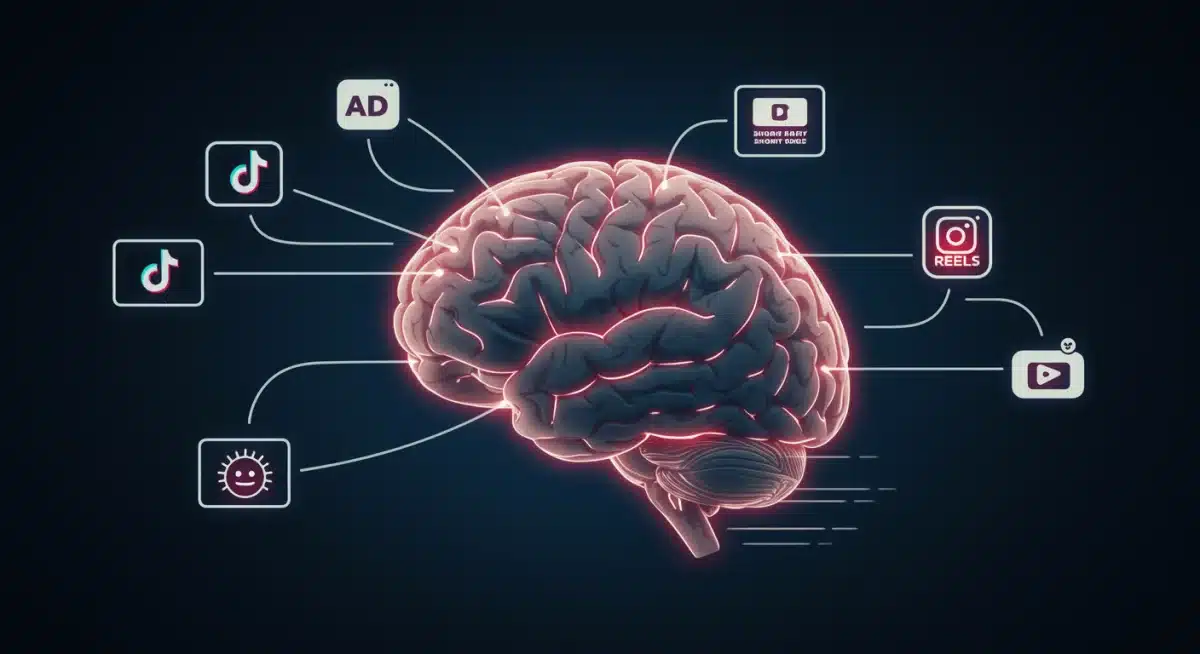
Neuroscientific research suggests that our brains are adapting to this fast-paced environment. The prefrontal cortex, responsible for executive functions like sustained attention, is constantly bombarded, leading to a preference for novelty and rapid task-switching. This adaptation, while beneficial for processing diverse information quickly, comes at the cost of deep, prolonged concentration.
- Information overload: The deluge of data from multiple sources overwhelms cognitive capacity.
- Multitasking illusion: The perceived ability to do several things at once actually reduces efficiency and focus on each individual task.
- Dopamine feedback loops: Social media platforms are designed to provide intermittent rewards, reinforcing short bursts of attention.
Understanding these underlying mechanisms is crucial for developing content that resonates. It’s not about blaming the audience for their lack of focus, but rather acknowledging an evolutionary shift driven by technological advancement. The challenge lies in creating meaningful interactions within these new cognitive parameters.
Ultimately, the digital age has fundamentally altered our relationship with attention. What was once a relatively stable cognitive resource is now a highly volatile and fragmented commodity. Adapting to this new reality is not just a strategic choice for content creators, but a necessity for survival in an increasingly competitive information ecosystem.
The rise of micro-content: short-form’s dominance
In response to the shrinking attention economy, micro-content has emerged as a dominant force. Platforms like TikTok, Instagram Reels, and YouTube Shorts have capitalized on the human brain’s preference for quick, digestible information, proving that brevity can indeed be the soul of engagement. These platforms thrive on videos often lasting less than 60 seconds, with many successful formats clocking in around the 6-second mark.
This isn’t just a trend among younger demographics; people of all ages are increasingly drawn to the immediate satisfaction and low cognitive load offered by micro-content. It fits seamlessly into busy schedules, offering entertainment or information during brief breaks, commutes, or even while waiting in line. The accessibility and shareability of these formats further amplify their reach and impact.
Why micro-content reigns supreme
- Instant gratification: Delivers immediate entertainment or value without a significant time commitment.
- High shareability: Easily consumed and passed along, fueling viral trends.
- Low commitment: Requires minimal cognitive effort, making it appealing during moments of distraction.
- Mobile-first design: Perfectly optimized for on-the-go consumption on smartphones.
The creative constraints of micro-content also force creators to be incredibly concise and impactful. Every second counts, leading to highly polished, attention-grabbing productions that get straight to the point. This discipline in creation is a direct response to the audience’s limited patience.
The prevalence of micro-content signifies a fundamental shift in how creators and consumers value time and attention. It’s a clear indicator that the future of digital engagement hinges on the ability to convey powerful messages in the shortest possible timeframe, making every single second count.
Is 6-second content truly the future? exploring the viability
While micro-content, especially in the 6-second format, has undeniable appeal, the question remains: is it truly the future for all content, or a specialized niche? The viability of 6-second content depends heavily on its purpose and the message it aims to convey. For quick brand recognition, punchy advertisements, or viral challenges, its effectiveness is proven. However, for nuanced storytelling, in-depth education, or complex product explanations, its limitations become apparent.
Consider the advertising industry, which has embraced 6-second bumper ads on YouTube. These ads are designed to be memorable, deliver a single clear message, and avoid intruding significantly on the viewer’s experience. Their success metrics often revolve around brand recall and awareness, rather than immediate conversion or detailed information transfer.
For more complex topics, content creators often employ a layered approach, using 6-second snippets to hook viewers and then directing them to longer-form content for deeper engagement. This strategy acknowledges the initial attention hurdle while still providing avenues for those who seek more comprehensive information.
Challenges and limitations of ultra-short formats
- Lack of depth: Difficult to convey complex ideas or detailed information.
- Contextual void: Can struggle to establish sufficient context for the message.
- Creative constraints: Requires extreme precision and creativity, which can be challenging to maintain consistently.
- Risk of misinterpretation: Brevity can sometimes lead to ambiguity or oversimplification.
The future likely involves a hybrid approach. While 6-second content excels at initial capture and sustained visibility, longer formats will continue to be essential for building deeper connections, fostering loyalty, and delivering substantial value. The key will be in strategically integrating these formats to create a cohesive and engaging user journey.
Therefore, while 6-second content is a powerful tool and an integral part of the modern content landscape, it’s more accurate to view it as a critical component of a diversified content strategy, rather than a universal replacement for all other forms of media.
Strategies for engaging audiences with limited attention
Engaging audiences with increasingly limited attention spans requires a strategic and multifaceted approach. It’s no longer enough to simply create content; one must actively fight for and retain precious seconds of focus. This involves understanding user behavior, optimizing content for various platforms, and consistently delivering value in concise, impactful ways.
The first few seconds of any content—be it a video, an article, or an advertisement—are paramount. A strong hook is non-negotiable. This could be a compelling question, a surprising statistic, a visually striking image, or an immediate promise of value. Without an effective hook, even the most brilliant content risks being scrolled past.
Crafting compelling short-form content
- Lead with value: Immediately provide the most important information or entertainment.
- Visual storytelling: Utilize strong visuals and dynamic editing to convey messages quickly.
- Clear call to action: Guide the viewer on what to do next, even if it’s just to watch more.
- Emotional resonance: Tap into emotions quickly to create a memorable impression.
- Platform optimization: Tailor content to the specific nuances and audience expectations of each platform.
Beyond the initial hook, maintaining engagement requires a continuous flow of interesting points or visual stimuli. For longer formats, this means breaking down information into easily digestible chunks, using subheadings, bullet points, and multimedia elements to prevent cognitive fatigue. For short-form, it means ensuring every frame and every word serves a purpose.
Ultimately, successful engagement in an attention-scarce world hinges on respecting the user’s time and delivering maximum impact with minimal investment from their side. It’s about being efficient, compelling, and constantly aware of the fleeting nature of digital focus.
The impact on content creation and marketing

The profound shift towards shorter attention spans has fundamentally reshaped the content creation and marketing industries. Brands and creators are now forced to adopt new methodologies, tools, and mindsets to remain relevant and effective. The days of long, rambling intros and slow narrative builds are largely over; immediacy and impact are the new currencies.
Content creators must become masters of conciseness, capable of distilling complex ideas into bite-sized, shareable formats. This often requires a deeper understanding of target audiences, what truly captures their interest, and how to deliver that value within severe time constraints. The emphasis has shifted from quantity to quality of engagement per second.
Adapting marketing strategies for the modern consumer
Marketers are increasingly leveraging data analytics to understand when and how audiences drop off, allowing them to optimize content for peak engagement. A/B testing various short-form ad creatives and video hooks has become standard practice. The focus is on creating content that not only stops the scroll but also encourages some form of interaction, however brief.
- Atomic content strategy: Breaking down large pieces of content into smaller, reusable components.
- Personalization: Delivering highly relevant content to individual users to maximize engagement.
- Interactive formats: Quizzes, polls, and augmented reality experiences capture attention more effectively.
- Cross-platform distribution: Adapting content for diverse platforms, each with its own audience and format expectations.
The rise of influencer marketing is also a direct consequence of this shift. Trustworthy voices can quickly cut through the noise, delivering messages in an authentic and engaging manner that resonates with their followers, often through short-form video. This bypasses traditional advertising fatigue and leverages established attention channels.
In essence, the content and marketing landscape has become a high-stakes arena where attention is the ultimate prize. Those who master the art of concise, impactful communication will thrive, while those who fail to adapt risk being lost in the ever-increasing digital din.
Beyond the buzz: balancing short-form and long-form content
While the allure of 6-second content and micro-formats is strong, a balanced approach that integrates both short-form and long-form content is crucial for a comprehensive and effective strategy. Dismissing long-form content entirely would be a mistake, as it serves distinct purposes that short-form cannot fulfill, particularly in building authority, fostering deep engagement, and providing comprehensive information.
Short-form content excels at initial capture and broad reach, acting as a powerful gateway. It can introduce new audiences to a brand, product, or idea, pique their curiosity, and drive them towards more in-depth resources. Think of it as the headline that grabs attention, while long-form content is the detailed article that provides the full story.
Long-form content, such as detailed blog posts, comprehensive guides, podcasts, or extended video documentaries, allows for nuanced discussions, complex explanations, and the building of a strong emotional connection. It is where true expertise is demonstrated and where audiences can invest their time to gain significant value. For SEO, long-form content often performs better, as it provides more opportunities for keywords and demonstrates authority to search engines.
Creating a cohesive content ecosystem
The challenge lies in creating a seamless journey between these two content types. A common strategy involves using short-form content to highlight key takeaways or compelling snippets from a longer piece, then providing clear calls to action that lead users to the full version. This creates a content ecosystem where each format plays a complementary role.
- Teaser strategy: Use short clips to preview longer videos or articles.
- Deep dives: Offer comprehensive guides or whitepapers for those seeking extensive knowledge.
- Cross-promotion: Link short-form content on social media to long-form content on websites or blogs.
- Repurposing: Transform elements of long-form content into multiple short-form pieces and vice versa.
Ultimately, the most successful content strategies will be those that intelligently leverage the strengths of both short-form and long-form content. It’s not an either/or situation, but rather a strategic integration that caters to the diverse needs and attention patterns of modern audiences, ensuring both immediate engagement and lasting impact.
The future of attention: adaptability and innovation
The ongoing evolution of attention spans necessitates a continuous commitment to adaptability and innovation in the content landscape. While 6-second content has carved out a significant niche, the true future of attention lies in the ability of creators and marketers to remain agile, experiment with new formats, and deeply understand the ever-changing psychological underpinnings of human engagement. It’s not about rigid adherence to a single format but about dynamic response to audience behavior.
Predicting the exact next iteration of content consumption is challenging, but certain principles will remain constant. Value, authenticity, and relevance will always cut through the noise, regardless of the content’s length. The platforms and formats may shift, but the human desire for compelling stories and useful information endures.
Embracing emerging technologies and trends

Emerging technologies like augmented reality (AR), virtual reality (VR), and interactive AI-driven content are poised to offer new ways to capture and sustain attention. These immersive experiences can provide novel forms of engagement that transcend traditional screen-based consumption, creating deeper, more memorable interactions.
- Personalized content feeds: AI algorithms will further refine content delivery, matching user preferences with unprecedented accuracy.
- Interactive storytelling: Choose-your-own-adventure narratives or gamified content experiences.
- Audio-first content: Podcasts and audio snippets catering to passive consumption during other activities.
- Live streaming: Real-time, unscripted content that fosters a sense of community and immediacy.
The ability to analyze data and derive actionable insights will become even more critical. Understanding not just what content performs well, but why it performs well, will inform future creative decisions. This data-driven approach, combined with creative intuition, will be the hallmark of successful content strategies moving forward.
In conclusion, the future of attention is not about a singular format but about a fluid ecosystem where content creators continuously adapt, innovate, and experiment. The goal remains the same: to connect with audiences meaningfully, even as the very nature of human attention continues its fascinating and rapid evolution.
| Key Point | Brief Description |
|---|---|
| Attention Span Decline | Digital saturation and constant stimulation have significantly reduced average human attention spans. |
| Micro-Content Rise | Short-form content (e.g., 6-second videos) dominates platforms, catering to instant gratification. |
| Hybrid Content Strategy | Effective engagement requires balancing short-form hooks with long-form depth for comprehensive value. |
| Adaptability is Key | The future demands continuous innovation and understanding of evolving user behaviors and technologies. |
Frequently asked questions about attention spans and content
Yes, research suggests that the average human attention span has decreased significantly over the past few decades, largely due to the constant stimulation and information overload from digital devices and social media platforms. This shift impacts how effectively individuals can focus on tasks.
6-second content refers to ultra-short video clips or advertisements designed for maximum impact in minimal time. It’s prominently used on platforms like TikTok, Instagram Reels, YouTube Shorts, and as bumper ads on YouTube, aiming to quickly capture attention and convey a concise message.
Directly communicating complex topics in true short-form (e.g., 6 seconds) is challenging due to inherent brevity. However, short-form content can be used to create compelling hooks or teasers that direct audiences to longer, more detailed content for comprehensive explanations and deeper engagement.
Marketers adapt by prioritizing strong hooks, visual storytelling, and concise messaging. They often employ a hybrid strategy, using short-form content for initial engagement and driving traffic to longer-form content for deeper conversions. Personalization and data analytics also play crucial roles.
No, long-form content is unlikely to disappear. While short-form excels at initial capture, long-form remains vital for building authority, providing comprehensive information, and fostering deeper connections. The future will likely see a strategic integration of both, where each format complements the other.
Conclusion
The discourse surrounding shorter attention spans and the potential dominance of 6-second content highlights a critical juncture in how we create and consume information. While the digital age has undeniably rewired our brains for quicker consumption, the answer isn’t a wholesale abandonment of longer formats. Instead, the most effective strategies will embrace a nuanced approach, utilizing the undeniable power of micro-content to capture fleeting attention, while simultaneously providing pathways to richer, more in-depth experiences for those who seek them. The future of content is not about a singular length, but about intelligent design, adaptability, and a deep understanding of human psychology in a perpetually evolving digital landscape.