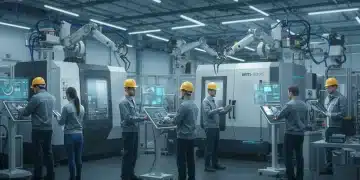
AI’s Impact on US Jobs: Most Affected Industries in 2 Years
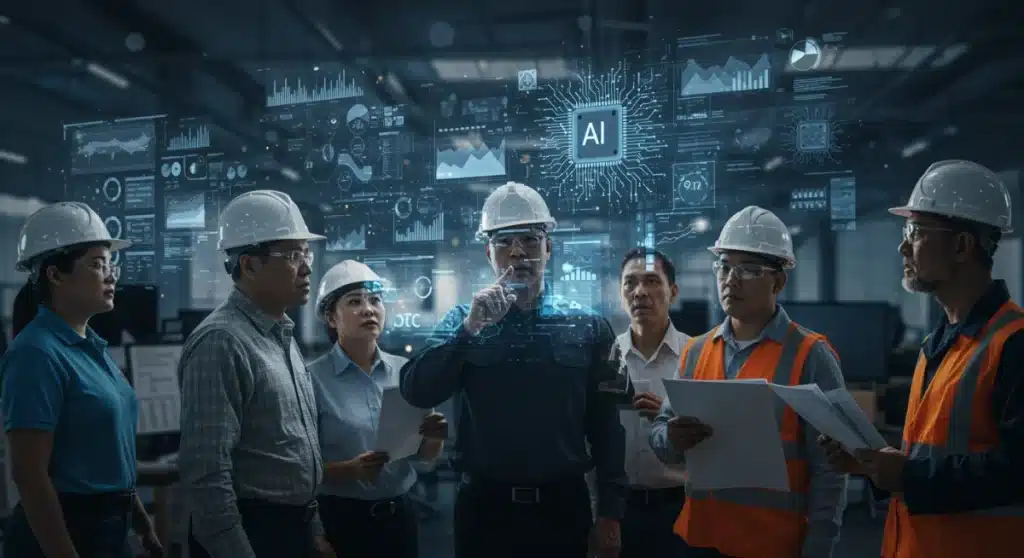
Artificial intelligence is set to significantly transform the US job landscape within the next two years, with certain industries facing considerable disruption and others experiencing unprecedented growth and new opportunities.
The rise of artificial intelligence is no longer a distant futuristic concept; it’s a present-day reality rapidly reshaping our world. For American workers, understanding the impact of AI on US jobs: which industries will be most affected in the next 2 years? is crucial. This isn’t just about job displacement, but also about the emergence of new roles, the evolution of existing ones, and the imperative for a dynamic workforce.
Understanding the AI Revolution and its Scope
The artificial intelligence revolution is fundamentally altering how businesses operate, from automating mundane tasks to enabling complex data analysis and decision-making. This technological shift is not merely an incremental improvement; it represents a paradigm shift with profound implications for the labor market across the United States. The scope of AI’s influence extends far beyond tech companies, touching every sector imaginable.
AI’s capabilities are expanding at an astonishing rate. What was once considered science fiction, such as natural language processing and advanced machine learning, is now commonplace. This rapid evolution means that the two-year horizon for significant job impact is not an exaggeration but a realistic timeframe for substantial changes to manifest.
The Dual Nature of AI’s Impact
AI’s influence on jobs is often viewed through a binary lens: either it creates jobs or it destroys them. However, the reality is far more nuanced. AI simultaneously automates, augments, and creates work. Understanding this multifaceted impact is key to preparing for the future.
- Automation: Repetitive, rule-based tasks are highly susceptible to AI automation, leading to potential job displacement in certain areas.
- Augmentation: AI tools can enhance human capabilities, making workers more efficient and effective, thereby changing job descriptions rather than eliminating them.
- Creation: The development, deployment, and maintenance of AI systems themselves generate entirely new job categories and industries.
This dual nature means that while some roles may diminish, others will evolve, and new opportunities will arise for those with adaptable skills. The challenge lies in managing this transition effectively, ensuring that the workforce is equipped to embrace these changes rather than be overwhelmed by them.
In essence, the AI revolution demands a re-evaluation of traditional job structures and a proactive approach to skill development. The coming two years will serve as a critical period to observe and adapt to these sweeping changes across the US economy.
Administrative and Office Support Roles: High Vulnerability
Administrative and office support roles are among the industries most susceptible to significant disruption from AI within the next two years. These positions often involve highly repetitive, data-driven tasks that AI and automation technologies are exceptionally good at handling. From scheduling appointments to managing databases and processing invoices, many core functions of these roles can be streamlined or entirely taken over by intelligent systems.
Consider the daily operations within a typical office environment. Tasks like transcribing notes, organizing digital files, responding to routine emails, and even basic data entry can now be performed with greater speed and accuracy by AI-powered software. This efficiency gain, while beneficial for businesses, directly impacts the demand for human labor in these specific areas.
Examples of Affected Roles
Several specific roles within administrative support face heightened vulnerability. These include:
- Data Entry Clerks: AI can automatically extract and process information from various sources, reducing the need for manual input.
- Administrative Assistants: AI scheduling tools, email management systems, and virtual assistants can handle many organizational and communication tasks.
- Receptionists: AI-powered chatbots and automated phone systems can manage initial inquiries, direct calls, and provide basic information, particularly in high-volume settings.
- Bookkeepers: Automated accounting software, enhanced by AI, can reconcile accounts, process transactions, and generate financial reports with minimal human intervention.
The shift isn’t always about outright elimination. In many cases, these roles will be augmented, requiring existing staff to take on more complex, strategic tasks that AI cannot yet perform. However, the sheer volume of routine work that can be automated suggests a substantial reduction in the overall number of positions or a significant redefinition of their scope. The next two years will likely see many organizations actively implementing these AI solutions, leading to a palpable impact on the administrative workforce.
Manufacturing and Production: Automation Accelerates

The manufacturing and production sectors in the US are already well into their automation journey, and AI is set to accelerate this transformation dramatically within the next two years. While robots have been a staple in factories for decades, AI brings a new level of intelligence, adaptability, and precision to these automated systems. This means not just repetitive physical tasks but also more complex processes involving quality control, predictive maintenance, and supply chain optimization are becoming increasingly AI-driven.
The push for greater efficiency, reduced costs, and enhanced safety is a primary driver for AI adoption in manufacturing. US companies are investing heavily in smart factories where AI orchestrates various production stages, from raw material handling to final product assembly and packaging. This integration of AI allows for real-time adjustments, minimizes waste, and significantly boosts output.
AI’s Role in Modern Manufacturing
AI’s application in manufacturing extends beyond simple robotics. It encompasses several advanced functionalities:
- Predictive Maintenance: AI analyzes sensor data from machinery to predict equipment failures before they occur, reducing downtime and maintenance costs.
- Quality Control: AI-powered vision systems can detect defects in products with greater accuracy and speed than human inspectors.
- Robotics and Automation: More sophisticated AI-driven robots can perform intricate assembly tasks, handle delicate materials, and adapt to changing production requirements.
- Supply Chain Optimization: AI algorithms can forecast demand, optimize logistics, and manage inventory levels more efficiently, leading to smoother operations.
While some fear widespread job losses, the reality is often a shift in job descriptions. Workers might transition from manual assembly to overseeing AI-powered machinery, programming robots, or analyzing data generated by smart systems. However, the sheer scale of automation means that a substantial number of entry-level and repetitive production jobs will likely be replaced, necessitating significant reskilling efforts for the existing workforce. The next 24 months will be crucial for manufacturers to implement these technologies and for workers to adapt to the evolving demands of the industry.
Customer Service and Call Centers: A New Frontier for AI
Customer service and call center operations are experiencing a profound transformation due to AI, and this trend is poised to accelerate significantly in the next two years across the US. Historically, these roles have been highly labor-intensive, relying on human agents to handle inquiries, resolve issues, and provide support. However, AI-powered chatbots, virtual assistants, and sophisticated natural language processing (NLP) systems are rapidly changing this landscape, offering businesses the ability to handle a vast volume of customer interactions with greater efficiency and consistency.
The primary driver for AI adoption in customer service is the desire to reduce operational costs, improve response times, and provide 24/7 support. AI can manage routine queries, guide customers through troubleshooting steps, and even process basic transactions, freeing up human agents to focus on more complex, empathetic, or high-value interactions. This shift doesn’t necessarily mean the complete elimination of human customer service, but rather a significant restructuring of the roles and responsibilities involved.
How AI is Reshaping Customer Interactions
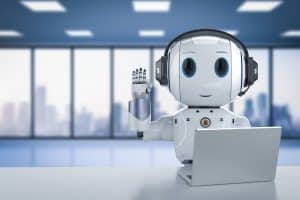
The integration of AI in customer service is multifaceted, impacting various aspects of the customer journey:
- Chatbots and Virtual Assistants: These AI agents can handle a large percentage of common customer questions, providing instant responses and directing users to relevant information or resources.
- Automated Self-Service: AI-driven portals and voice systems allow customers to resolve issues independently, from checking order statuses to updating account information.
- Sentiment Analysis: AI can analyze customer tone and language to gauge satisfaction levels and flag interactions that require human intervention, ensuring quality service.
- Agent Augmentation: AI tools provide human agents with real-time information, suggesting responses and solutions, thereby increasing their efficiency and effectiveness.
While the goal is often to enhance the customer experience, the reality is that many entry-level customer service positions, particularly those handling repetitive inquiries, are at risk of being automated. The demand for human agents will likely shift towards roles requiring advanced problem-solving skills, emotional intelligence, and the ability to manage AI systems. Over the next two years, we can expect to see a substantial reduction in the number of traditional call center roles and a greater emphasis on digitally-assisted customer support models.
Transportation and Logistics: Autonomous Systems on the Horizon
The transportation and logistics sectors in the US are on the cusp of a major transformation driven by AI, with autonomous systems expected to have a noticeable impact within the next two years. While fully autonomous vehicles are still some way off for widespread public use, AI is already being integrated into various aspects of logistics, from warehouse automation to route optimization and predictive fleet maintenance. The promise of increased safety, efficiency, and reduced operational costs makes AI an irresistible force in these industries.
Long-haul trucking, last-mile delivery, and warehousing operations are particularly vulnerable to AI-driven automation. Companies are actively investing in autonomous forklifts, drones for inventory management, and self-driving trucks for highway segments. These technologies aim to solve challenges such as labor shortages, fuel efficiency, and the need for faster, more reliable delivery networks.
Key Areas of AI Disruption
The impact of AI in transportation and logistics will manifest in several critical ways:
- Autonomous Vehicles: While regulatory hurdles remain, AI-powered self-driving trucks are already being tested and deployed in limited capacities, potentially reducing the demand for human drivers on long routes.
- Warehouse Automation: Robots guided by AI are increasingly handling tasks like sorting, picking, and packing, leading to fewer manual labor positions in large fulfillment centers.
- Route Optimization: AI algorithms can analyze real-time traffic, weather, and delivery schedules to determine the most efficient routes, reducing fuel consumption and delivery times.
- Predictive Fleet Maintenance: AI monitors vehicle performance to predict maintenance needs, preventing breakdowns and extending the lifespan of transportation assets.
The transition will not be instantaneous, but the trajectory is clear. Over the next two years, we will see a significant increase in pilot programs and scaled deployments of autonomous technologies in logistics hubs and specific transportation corridors. This will inevitably lead to a re-evaluation of human roles, requiring existing workers to adapt to supervisory positions, maintenance of AI systems, or transitioning to new opportunities created by the evolving industry landscape.
Finance and Accounting: Efficiency Through Intelligent Automation
The finance and accounting industries in the US are undergoing a significant shift, with AI and intelligent automation poised to bring about substantial changes within the next two years. These sectors, traditionally reliant on meticulous data processing, complex calculations, and regulatory compliance, are prime candidates for AI integration. AI can automate repetitive tasks, enhance fraud detection, improve risk assessment, and provide deeper insights into financial data, leading to greater efficiency and accuracy.
Financial institutions, from large banks to smaller accounting firms, are increasingly adopting AI to streamline back-office operations, manage customer portfolios, and ensure adherence to ever-evolving regulations. This drive for efficiency and precision means that many traditional roles within these fields will either be significantly augmented or, in some cases, partially automated.
AI’s Transformative Role in Finance
AI is impacting various functions within finance and accounting:
- Automated Data Processing: AI can rapidly process and reconcile vast amounts of financial data, reducing the need for manual data entry and review.
- Fraud Detection: AI algorithms can analyze transaction patterns to identify anomalies and potential fraudulent activities with higher accuracy than human analysts.
- Risk Assessment: Machine learning models can evaluate credit risk and investment opportunities more effectively by processing complex datasets and predicting outcomes.
- Compliance and Reporting: AI can help monitor regulatory changes, automate compliance checks, and generate accurate financial reports, minimizing human error.
While high-level financial analysts, strategists, and client-facing advisors will likely see their roles augmented by AI, allowing them to focus on more strategic work, many entry-level and mid-level positions involving routine data handling, transaction processing, and basic auditing are at a higher risk of automation. The next two years will be critical for finance professionals to embrace new skills in data analytics, AI system management, and strategic interpretation, as the industry moves towards more intelligent and automated workflows.
Emerging Opportunities and Reskilling Imperatives

Despite the potential for job displacement in certain sectors, the rise of AI also presents a significant wave of emerging opportunities and underscores the critical need for reskilling across the US workforce. As AI automates existing tasks, it simultaneously creates new roles and demands for specialized skills that are essential for the development, deployment, and management of these advanced technologies. This isn’t just about adapting to change; it’s about actively shaping the future of work.
The next two years will be a pivotal period for individuals and organizations to invest in new capabilities. The focus will shift from performing repetitive tasks to roles that require creativity, critical thinking, emotional intelligence, and expertise in AI systems. This imperative for reskilling is not limited to tech professionals but extends to workers across all industries who need to learn how to collaborate with AI tools and leverage them effectively.
New Roles and Essential Skills
The AI landscape is generating a demand for diverse new roles and skill sets:
- AI Developers and Engineers: Professionals who design, build, and maintain AI models and algorithms.
- Data Scientists and Analysts: Experts who interpret complex data generated by AI and provide actionable insights.
- AI Ethicists and Policy Makers: Individuals focused on ensuring AI development is responsible, fair, and aligns with societal values.
- AI Trainers and Prompt Engineers: Roles centered around teaching AI systems and optimizing their interactions.
- Human-AI Collaboration Specialists: Professionals who bridge the gap between human teams and AI systems, ensuring seamless integration.
For existing workers, reskilling means acquiring proficiency in areas like data literacy, basic programming, critical thinking in an AI-driven environment, and soft skills such as adaptability and complex problem-solving. Educational institutions, corporate training programs, and government initiatives will play a crucial role in providing accessible pathways for workers to gain these necessary competencies. The proactive pursuit of these new skills will not only mitigate the risks of automation but also unlock unprecedented career growth in the evolving AI economy.
| Key Industry | AI Impact in 2 Years |
|---|---|
| Administrative Support | High vulnerability to automation of repetitive tasks like data entry and scheduling. |
| Manufacturing | Accelerated automation of production lines, quality control, and predictive maintenance. |
| Customer Service | Significant shift to AI chatbots and virtual assistants for routine inquiries; human roles become more complex. |
| Transportation & Logistics | Increased deployment of autonomous systems in warehousing and early stages of autonomous trucking. |
Frequently Asked Questions About AI’s Job Impact
Administrative and office support roles, manufacturing and production, customer service, and certain segments of transportation and logistics are highly vulnerable to AI automation within the next two years due to their repetitive and data-driven nature.
While AI will displace some jobs, particularly those involving routine tasks, it will also create new roles and augment existing ones. The overall impact is more about job transformation and requiring significant reskilling rather than mass unemployment.
Workers should focus on developing skills in data literacy, critical thinking, complex problem-solving, creativity, emotional intelligence, and basic proficiency with AI tools and systems to remain competitive.
No, many jobs will be augmented by AI, meaning AI tools will handle routine aspects, allowing human workers to focus on more strategic, creative, or empathetic tasks that require uniquely human capabilities. It’s often about collaboration, not replacement.
Businesses should invest in comprehensive reskilling and upskilling programs for their employees, foster a culture of continuous learning, and strategically integrate AI to augment human capabilities rather than solely focusing on displacement.
Preparing for an AI-Driven Future
The trajectory of artificial intelligence’s integration into the US economy over the next two years is clear: it will be transformative. While certain industries, particularly those characterized by repetitive and data-intensive tasks, face considerable disruption, the broader narrative is one of evolution rather than outright obsolescence. The proactive adaptation of both individuals and organizations through strategic reskilling, continuous learning, and the embrace of human-AI collaboration will define success in this rapidly emerging landscape. The future of work in America, shaped by AI, promises both challenges and unparalleled opportunities for those prepared to navigate its complexities.